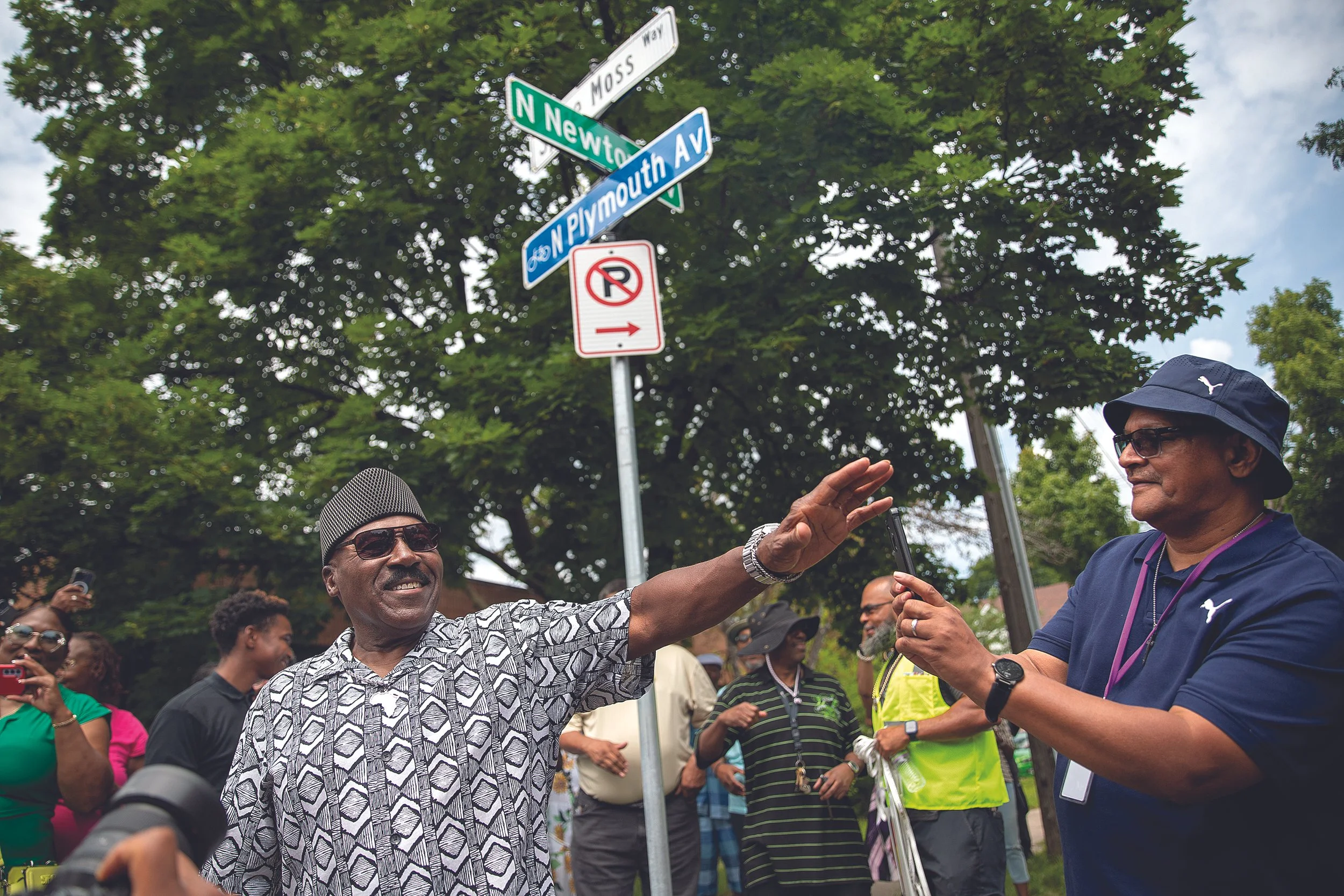
“They had to deal with my history, didn’t they,” Spike Moss said as people approached him with thanks and congratulations. Photo by Azhae’la Hanson, North News
When we talk about civil rights leaders, we often think of distant figures from history books. But some of the most important freedom fighters are still here, still organizing, still demanding justice in our own community. Spike Moss is one of them.
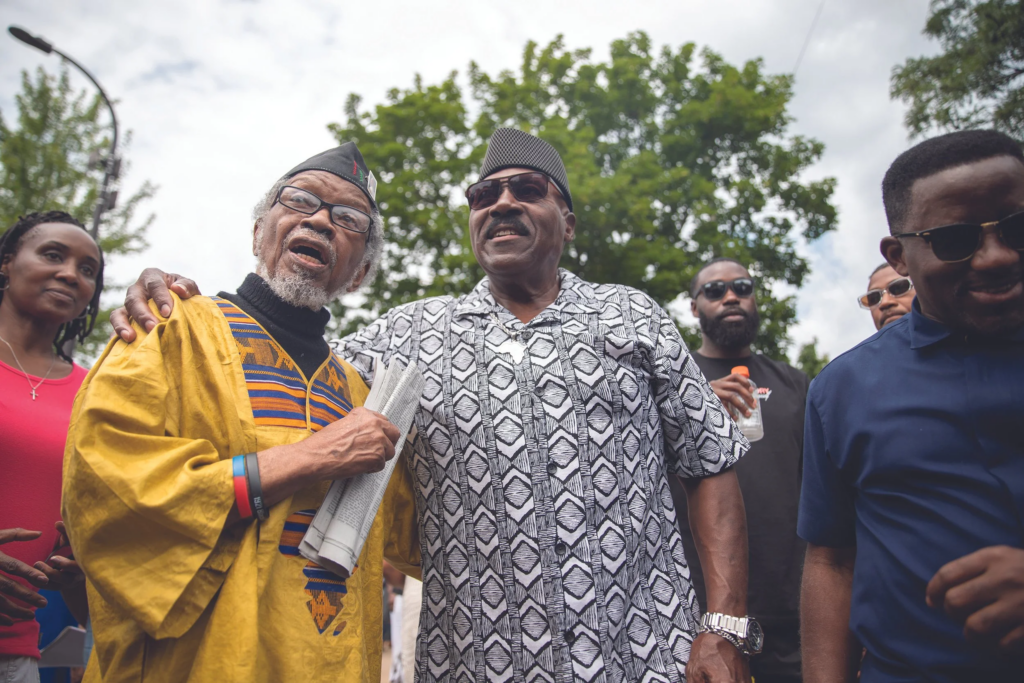
Moss stood with fellow civil rights leader Mahmoud El-Kati, left, after the unveiling. Photo by Azhae’la Hanson, North News
In 1966, after a Black girl was beaten by police with batons, north Minneapolis erupted in its first rebellion. Out of that pain came The Way Opportunities Unlimited, one of the first community centers built by and for the Black community in Minneapolis. Moss became its youngest director, creating space where young people could gather, organize, and be free. He spent decades fighting to desegregate Metro Transit, the fire department, and the police force at a time when those institutions refused to hire Black workers. Moss describes himself not as an activist but as a freedom fighter. The distinction matters. Freedom, justice, equality in that order. When Attorney General Keith Ellison announced the Derek Chauvin verdict in 2021, he said his mind was on Spike Moss, the first person who ever taught him “that you can organize, work and actually fight for justice and actually win some accountability.”
Last year, Plymouth Avenue between Newton and Lyndale was renamed Spike Moss Way, making him the first living man to have a street named after him in Minneapolis. The location is significant. It’s where The Way once stood before the Fourth Precinct Police Station was built in its place. The irony is not lost on anyone, especially Moss.
Across Minneapolis right now, the economic impact of aggressive immigration enforcement is being felt in every neighborhood. Families are facing impossible choices between paying bills and buying food. Workers are staying home rather than risk going out, losing income they desperately need. Small businesses that anchor our communities are seeing their customer base shrink. The financial strain is real and it’s urgent.
Support the Rapid Response Fund
Yet in the face of this hardship, we’re witnessing the power of community in action. People are organizing to support each other in ways that would make the leaders we’ve honored this month proud. Our Rapid Response Fund exists to meet this moment, providing emergency assistance with food, housing costs, and utilities to families who need help right now. Every dollar goes directly to keeping our neighbors stable during this difficult time.
Moss’s decades of work offer a blueprint for this moment. Local organizing matters. Building community institutions matters. Standing up for each other matters, even when it’s uncomfortable, even when the challenges feel overwhelming.
Your donation to the Rapid Response Fund puts that principle into action. It ensures that a family can afford groceries this week. It means a parent doesn’t have to choose between rent and utilities. It means our neighbors know they’re not alone.
Throughout this month, we’ve shared stories of leaders who acted despite fear. Thurgood Marshall used the law as a weapon for justice. Angela Davis transformed imprisonment into a lifelong fight for freedom. John Lewis put his body on the line for what was right. Martin Luther King Jr. showed us that love can dismantle oppression. Stokely Carmichael taught us that true liberation means building our own power. And Spike Moss reminds us that the work continues right here, in our own city, every single day.
These leaders didn’t wait for permission to fight for what was right. They didn’t let fear stop them. They built movements, supported each other, and refused to accept injustice as inevitable. The work they started is not finished. It lives in every person who chooses courage over comfort, solidarity over silence, action over despair.
Stand with your community. Act despite fear. Build the world we deserve.