Celebrating National Arts and Humanities Month at Pillsbury United Communities
When communities face uncertainty, artists often help us see what institutions cannot: the possibilities that exist beyond the challenges of today. Through storytelling, creativity, and cultural expression, artists have long helped communities find their voices, reclaim their narratives, and imagine a different future.
This October, as we celebrate National Arts and Humanities Month, we are reminded that the arts are not simply something to enjoy. They are essential to how communities connect, organize, heal, make meaning, and create change.
For generations, Pillsbury United Communities (PUC) has worked alongside Minnesota neighborhoods, recognizing that vibrant communities are built not simply through programs and services, but through relationships, shared experiences, and opportunities for neighbors to shape the places they call home.
Artists have always been central to building collective power.
Across our community centers, arts programming, and neighborhood partnerships, creativity opens doors that traditional institutions sometimes cannot. It creates porous platforms for young people to discover their voices, neighbors to understand one another, and communities to imagine new possibilities.
This is the power of people- and place-based work.
When organizations are deeply rooted in neighborhoods, they develop something that cannot be replicated through a grant cycle or strategic plan: relationships built on proximity, history, and trust.
Those relationships become especially important during moments of uncertainty.
During the height of the visible Operation Metro Surge, as intensified federal immigration enforcement created fear and perpetrated violent disruption across Twin Cities communities, PUC drew upon its neighborhood relationships to respond to emerging needs. Our response reinforced a fundamental truth: the value of community-based organizations is measured not only by the programs we operate, but by our ability to listen, adapt, and stand alongside our neighbors when crisis comes.
Artists are essential to that response.
Creative expression helps communities process trauma, preserve cultural lineage, challenge dominant narratives, and make visible the humanity behind complex public debates. Artists help us understand not only what is happening around us, but what might be possible beyond it.
The importance of arts and expression becomes especially visible in moments of community crisis, like Operation Metro Surge. During such a time of acute hardship, when our impulse was perhaps to turn away or go numb, our communities responded with unabashed expression and creativity that ignited our collective imagination and stirred us to engage more deeply with the nuance and complexity of what was unfolding in our neighborhoods, as well as the world at large. This sort of expression challenges us to show up for each other, encouraging us to participate and uniting us in civic action.
One such story, shared with me by a member of my immediate community in the spring of 2026, is a painful and detailed account of their experience of being detained during Operation Metro Surge, which they asked me to turn into graphic medicine. You can read it here.
Creative storytelling is also a necessary part of combating the false narratives that may surround a community. Through such authentic, in-the-moment expression, a community’s artists and storytellers also become its documenters, sharing the concealed stories of resistance that then serve as part of a shared public record. Cultural art and expression remind us of our humanity, both individual and collective, and help us to engage with that humanity, even when it is heavy and difficult. It is a vital tributary of the great river of justice and liberation.
—
Nonprofit, philanthropic, and elected leaders must resist treating arts and culture as secondary investments, particularly when budgets tighten or immediate needs grow. The arts are not a luxury reserved for times of stability. They are among the tools communities use to build belonging, resilience, and collective power.
That means investing in artists, supporting accessible creative spaces, and recognizing cultural institutions as essential partners in neighborhood development. It also means ensuring that residents, especially young people and residents of historically disinvested communities, can tell their own stories and influence decisions that shape their futures.
National Arts and Humanities Month is both a celebration of creativity and a reminder of our responsibility to sustain it. Serendipitously, four members of our leadership team gathered in Oakland, California this month to work with other Wallace Foundation grantees who are focused on arts-based work
At PUC, we believe stronger communities emerge when people have the resources to meet today’s challenges and the freedom to imagine tomorrow’s possibilities.
Artists have always been central to systems change. They challenge what we accept, illuminate what we overlook, and help communities envision futures that institutions alone cannot create. If we are serious about building more just, connected, and abundant communities, artists must remain supported and resourced in shaping what comes next.
-
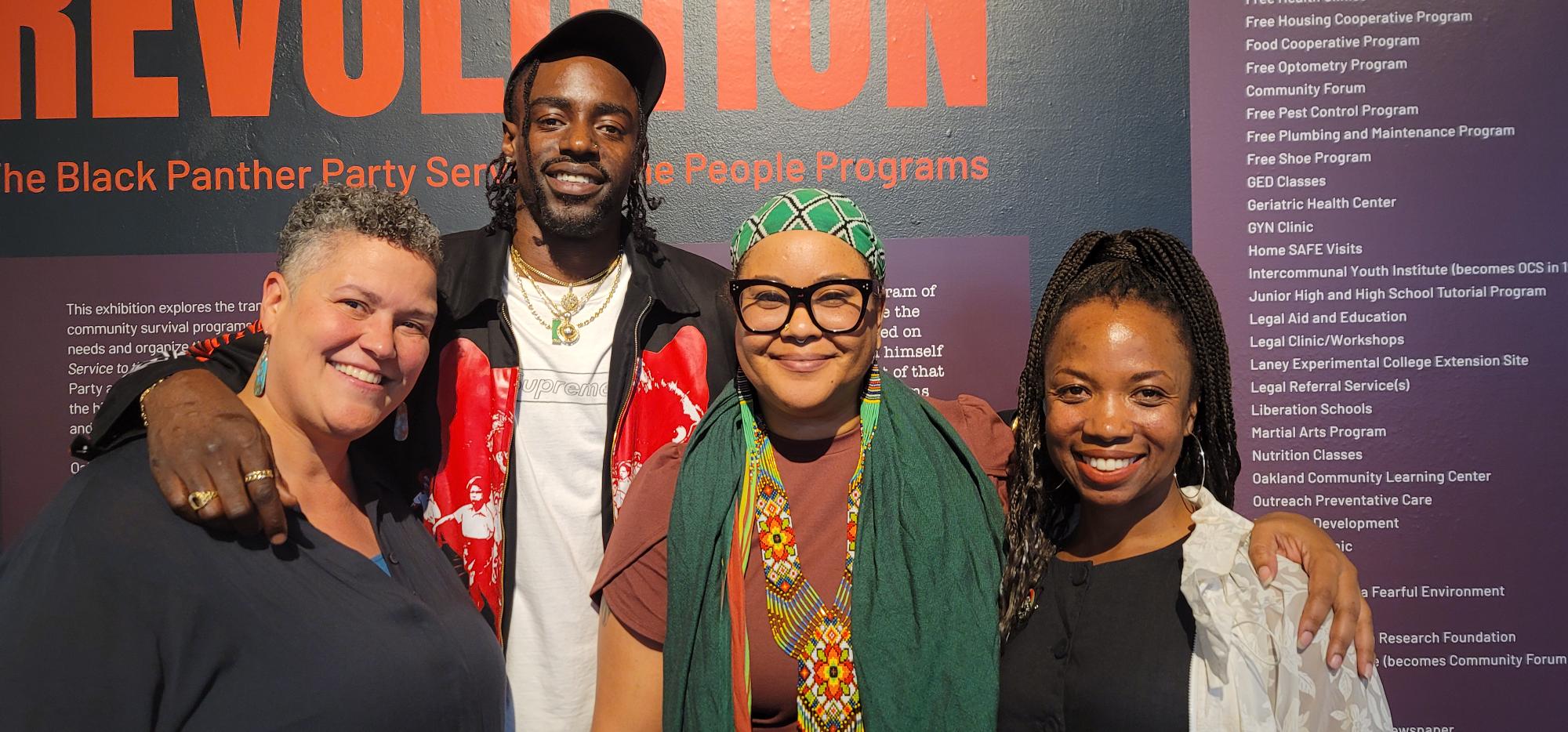
- PUC President, Signe V. Harriday, in Oakland, CA at the Black Panther Party Museum with colleagues from Laundromat Project and Artist as First Responder
For nearly 150 years, arts and culture have been a foundational element of the PUC mission. To support that mission, Click Here.