Art Is More Than Expression. It Is How Communities Build Their Future.

Celebrating National Arts and Humanities Month at Pillsbury United Communities

When communities face uncertainty, artists often help us see what institutions cannot: the possibilities that exist beyond the challenges of today. Through storytelling, creativity, and cultural expression, artists have long helped communities find their voices, reclaim their narratives, and imagine a different future.

This October, as we celebrate National Arts and Humanities Month, we are reminded that the arts are not simply something to enjoy. They are essential to how communities connect, organize, heal, make meaning, and create change.

For generations, Pillsbury United Communities (PUC) has worked alongside Minnesota neighborhoods, recognizing that vibrant communities are built not simply through programs and services, but through relationships, shared experiences, and opportunities for neighbors to shape the places they call home.

Artists have always been central to building collective power.

Across our community centers, arts programming, and neighborhood partnerships, creativity opens doors that traditional institutions sometimes cannot. It creates porous platforms for young people to discover their voices, neighbors to understand one another, and communities to imagine new possibilities.

This is the power of people- and place-based work.

When organizations are deeply rooted in neighborhoods, they develop something that cannot be replicated through a grant cycle or strategic plan: relationships built on proximity, history, and trust.

Those relationships become especially important during moments of uncertainty.

During the height of the visible Operation Metro Surge, as intensified federal immigration enforcement created fear and perpetrated violent disruption across Twin Cities communities, PUC drew upon its neighborhood relationships to respond to emerging needs. Our response reinforced a fundamental truth: the value of community-based organizations is measured not only by the programs we operate, but by our ability to listen, adapt, and stand alongside our neighbors when crisis comes.

Artists are essential to that response.

Creative expression helps communities process trauma, preserve cultural lineage, challenge dominant narratives, and make visible the humanity behind complex public debates. Artists help us understand not only what is happening around us, but what might be possible beyond it.

The importance of arts and expression becomes especially visible in moments of community crisis, like Operation Metro Surge. During such a time of acute hardship, when our impulse was perhaps to turn away or go numb, our communities responded with unabashed expression and creativity that ignited our collective imagination and stirred us to engage more deeply with the nuance and complexity of what was unfolding in our neighborhoods, as well as the world at large. This sort of expression challenges us to show up for each other, encouraging us to participate and uniting us in civic action.

One such story, shared with me by a member of my immediate community in the spring of 2026, is a painful and detailed account of their experience of being detained during Operation Metro Surge, which they asked me to turn into graphic medicine. You can read it here.

Creative storytelling is also a necessary part of combating the false narratives that may surround a community. Through such authentic, in-the-moment expression, a community’s artists and storytellers also become its documenters, sharing the concealed stories of resistance that then serve as part of a shared public record. Cultural art and expression remind us of our humanity, both individual and collective, and help us to engage with that humanity, even when it is heavy and difficult. It is a vital tributary of the great river of justice and liberation.

—

Nonprofit, philanthropic, and elected leaders must resist treating arts and culture as secondary investments, particularly when budgets tighten or immediate needs grow. The arts are not a luxury reserved for times of stability. They are among the tools communities use to build belonging, resilience, and collective power.

That means investing in artists, supporting accessible creative spaces, and recognizing cultural institutions as essential partners in neighborhood development. It also means ensuring that residents, especially young people and residents of historically disinvested communities, can tell their own stories and influence decisions that shape their futures.

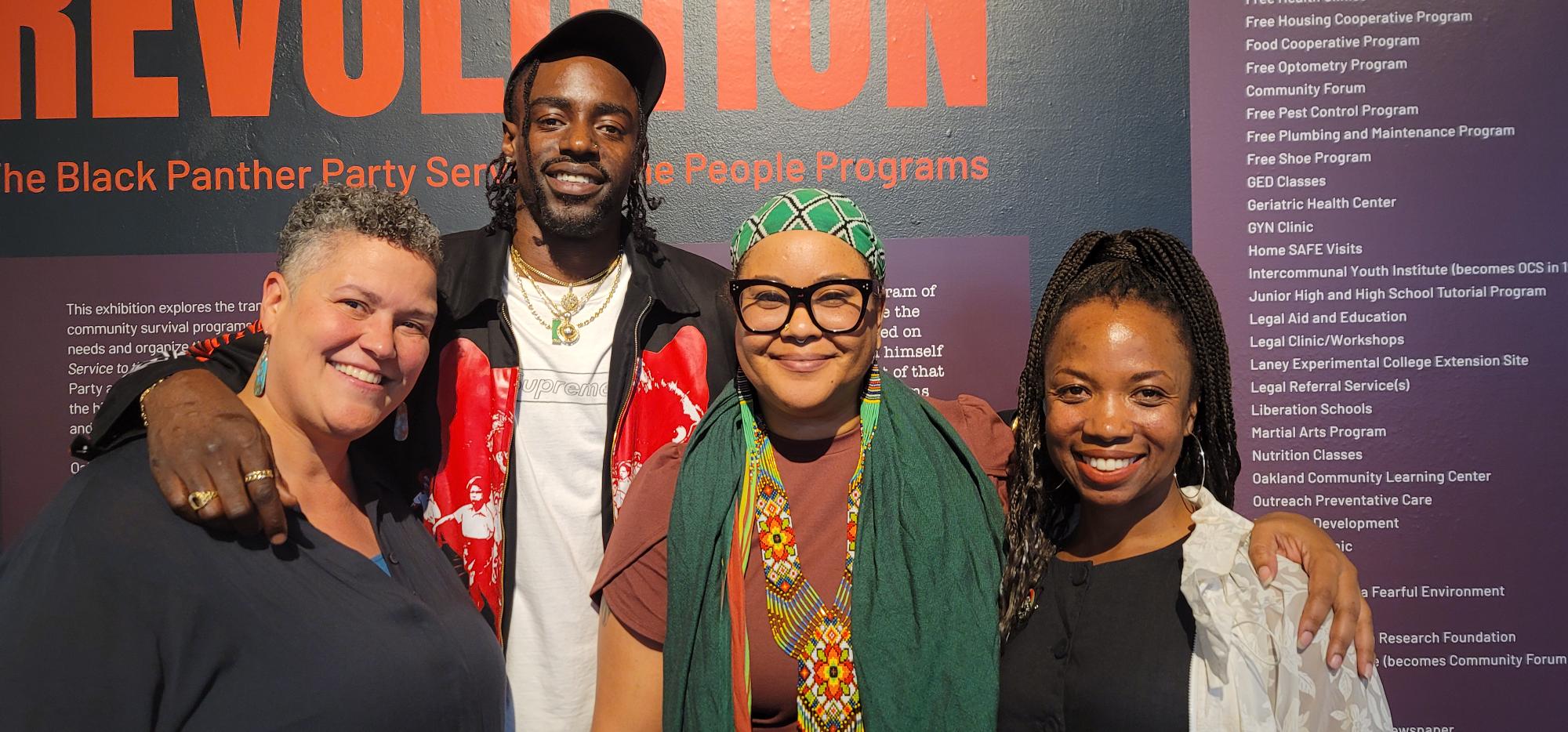
National Arts and Humanities Month is both a celebration of creativity and a reminder of our responsibility to sustain it. Serendipitously, four members of our leadership team gathered in Oakland, California this month to work with other Wallace Foundation grantees who are focused on arts-based work

At PUC, we believe stronger communities emerge when people have the resources to meet today’s challenges and the freedom to imagine tomorrow’s possibilities.

Artists have always been central to systems change. They challenge what we accept, illuminate what we overlook, and help communities envision futures that institutions alone cannot create. If we are serious about building more just, connected, and abundant communities, artists must remain supported and resourced in shaping what comes next.

For nearly 150 years, arts and culture have been a foundational element of the PUC mission. To support that mission, Click Here.
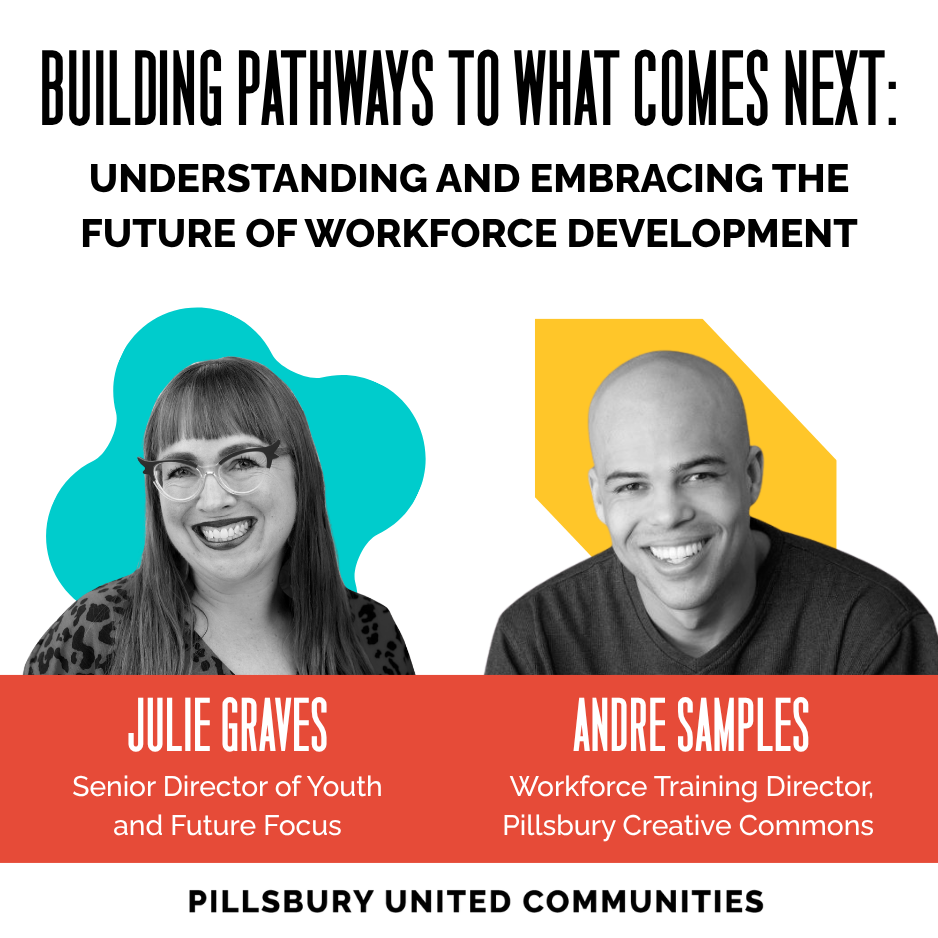
Building Pathways to What Comes Next: Understanding and Embracing the Future of Workforce Development

Work has always been about more than earning a paycheck. At its best, work creates independence, builds confidence, connects us to one another, and gives people the opportunity to imagine a different future for themselves and their families.

During Workforce Development Month, we celebrate the people who make those possibilities real: young people stepping into their first jobs, workers building new skills, employers opening doors, mentors sharing what they know, and community organizations connecting talent and opportunity.

For generations, Pillsbury United Communities (PUC) has worked alongside communities as economies and neighborhoods have changed. Today, workforce development is not simply about helping someone find a job, but helping people build the skills, relationships, experiences, and confidence to thrive in a changing world.

You can see that philosophy across PUC.

At Full Cycle, bicycles become much more than bicycles. Young adults gain hands-on work experience while learning responsibility, problem-solving, teamwork, and the rhythms of a workplace. Across our social enterprises, businesses create economic value while becoming places where people learn, grow, lead, and discover their abilities. PUC also connects 18–24-year-olds who don’t envision themselves in two- or four-year degree programs to high-demand credentials and certificates that can be earned in nine months or less. Programs like HVAC, phlebotomy, barbering, and CNA training lead to direct employment opportunities while giving students a sense of purpose providing needed services in community.

Our partnership with the City of Minneapolis through Step Up creates another doorway. A summer internship may seem like a small experience in the arc of a career, but entering a professional environment, meeting a mentor, building a network, and seeing yourself differently can have an impact far beyond one summer.

The same is true of our theater-based Technical Arts Training @ Pillsbury, where people discover careers in production, lighting, sound, stagecraft, and the many professions that bring creative work to life. Sometimes workforce development begins with skills training. Sometimes it begins by helping someone discover that a career they never knew existed could belong to them.

Together with our broader youth development work, these experiences reflect a belief that has long guided PUC. Talent is everywhere, even when opportunity is not.

That belief matters enormously today.

Our economy is changing quickly. Employers face new skill demands and economic uncertainty while workers navigate rising costs, shifting industries, and persistent disparities in opportunity. Race, geography, income, education, and professional networks still have far too much influence over who gets an opportunity and who does not.

Artificial intelligence is adding another layer of change. AI will reshape jobs, automate tasks, create new occupations, and change the skills employers value. It holds tremendous promise, but history reminds us that technological progress does not automatically produce shared prosperity. Without intentional action, innovation can deepen existing divides just as easily as it can expand opportunity.

For workforce development organizations, the challenge is bigger than teaching people to use the latest technology. We must prepare people to navigate change itself.

That means combining technical skills with deeply human capabilities that will become even more valuable in an AI-enabled economy: curiosity, judgment, creativity, communication, collaboration, leadership, and adaptability. It means strengthening connections between young people and employers, neighborhoods and growing industries, and people with talent and institutions with the power to open doors.

It also means listening.

Community-based organizations like PUC occupy a unique place in this work because we are connected to people across many parts of their lives. Our community centers, youth programs, arts and cultural work, social enterprises, neighborhood relationships, and employer partnerships allow us to see possibilities that don’t always fit neatly inside traditional workforce systems.

Our opportunity is to bring those pieces together more intentionally.

Imagine a young person entering a PUC community center, discovering a passion through an arts or youth program, gaining work experience through Full Cycle or Step Up, developing specialized skills through an apprenticeship, meeting a mentor, and beginning a career they could not have imagined a few years earlier.

That is more than a workforce program. It is an ecosystem of possibility.

As we celebrate Workforce Development Month, we are proud of what PUC and our partners have built. But we are even more interested in what comes next.

The future of work is still being written. Technology, employers, and public policy will help shape it. Communities must help shape it too.

At Pillsbury United Communities, we believe the measure of that future should not simply be how many jobs our economy creates or how sophisticated our technology becomes. It should be whether more people can see a place for themselves in that future, whether opportunity reaches neighborhoods too often left outside prosperity, and whether the next generation has the tools and confidence to build lives of purpose and possibility.

That is the future of workforce development we want to help create.

If you would like to support this important work, feel free to donate Here!

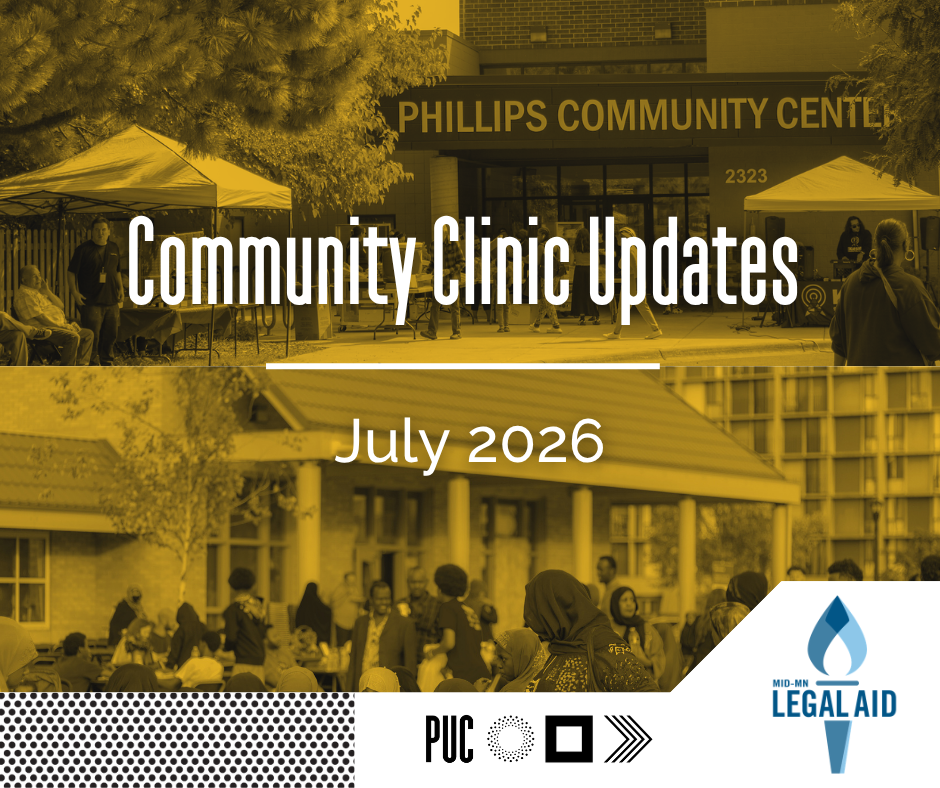
News & Updates from Mid-Minnesota Legal Aid’s Community Clinics: July 2026

Mid Minnesota Legal Aid (“MMLA”) partners with PUC to host in-person legal clinics at Brian Coyle and Waite House to provide a variety of free legal services to low-income and elderly clients.

In this July edition of our report to PUC check out a note about how to prepare for a criminal record expungement, a story and lesson about evictions, and the clinic’s statistics from June!

Brian Coyle Center Legal Clinic

Legal Aid’s Legal Clinic at the Brian Coyle Center (420 15th Ave S, Minneapolis, MN 55454) offers nearly every legal service that Mid Minnesota Legal Aid offers. See a list of our services below.

One of the services listed is “Criminal Expungements.” If you want to clear your criminal record with a criminal expungement you need to prove to the court that you have “rehabilitated” and that your criminal record is harming you. So, you should document every time your criminal record harms you. That means saving any job application denials that state you were rejected because of your criminal record. The same goes for denied rental applications. Once the time comes to expunge your criminal record you will be much better prepared to do so.

Monday, Tuesday, and Wednesday 9 AM – 3 PM (General Civil)

  • Guardianship
  • Divorce
  • Custody
  • Evictions
  • Public Benefits
  • Consumer Issues
  • Criminal Expungement
  • Eviction Expungement
  • Damaged/Unsafe Housing
  • Section 8 Issues
  • Lost Security Deposits

Thursday 9 AM – 3 PM (Immigration)

  • Naturalization
  • Green Cards
  • Derivative Citizenship
  • Adjustment of Status
  • U/T Visa
  • VAWA

Waite House Legal Clinic

MMLA’s immigration legal clinic at Waite House (2323 11th Ave S, Minneapolis, MN 55404) provides brief services and advice for immigration matters including: pro se asylum applications, pro se work card applications, and brief advice and consultations. It is open every Monday from 10 a.m. to 2 p.m. Appointments can be made with the front desk staff at Waite House. Walk-ins are welcome, but they are not guaranteed to be seen—appointments are strongly preferred. All staff at the Waite House Legal Clinic speak Spanish and English.

A Story and a Lesson

This spring, a man came into the Brian Coyle Center Legal Clinic because he was being told to leave his apartment. For the last two years he was a live-in-caretaker for his disabled wife. Unfortunately, she passed away. Within days of her passing the owner of the apartment told him he had 14 days to remove all property from the apartment and leave. This was impossible for the grieving husband.

He tried to negotiate with the apartment owner to get more time to move out. He needed more time to find an apartment to move to. He needed more time to pack up all his wife’s and his property. He needed more time to just grieve his deceased wife. The owner of the apartment did not give him more time. Instead, the owner brought an eviction against the husband.

The man came to the Brian Coyle Center Legal Clinic, and Frank got to work. The goal was to get the man moved out before the first eviction court hearing. Fortunately, he found an apartment; however, he could not move out before the first court hearing.

The man and Frank went to court armed with an argument to buy him more time. Fortunately, they were able to negotiate with the owner to get one more week to move out.

Now the man lives in a new apartment, he moved his wife’s property into a storage unit, and the court expunged the eviction off his record. He finally has the time and space to process the passing of his wife.

The lesson here is about how to avoid getting an eviction on your record even when you are facing an eviction. When a landlord files an eviction against a tenant the eviction is on the record. But the tenant still can get the court to expunge it!

If the eviction is because the tenant did not pay rent, then the tenant has at-least until the first court date to pay that rent. Then the tenant can ask the landlord to dismiss and expunge the case. It’s the same when the eviction is because the tenant is staying in the apartment past the end of the lease. If the tenant gives up possession of the apartment before the first court hearing the court is very likely to expunge the case.

If you are facing an eviction you should talk with a lawyer to discuss how to put yourself in the best position to expunge that eviction from your record. You can come to the Brian Coyle Center, call Mid Minnesota Legal Aid’s intake line (877-696-6529), or request a free lawyer at your first court appearance.

A Look at the Numbers

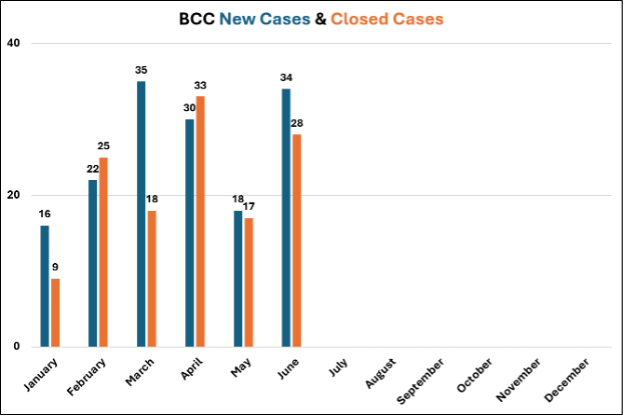
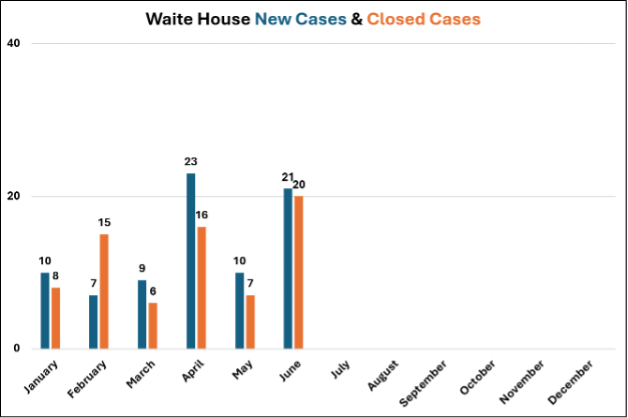
In May the Brian Coyle Center Legal Clinic opened 18 new cases and closed 17 cases. During that same time, Waite House opened 10 cases and closed 7 cases! Both clinic sites saw a decrease in numbers. It is not clear why the numbers are lower. May 25th was memorial day and May 27th was Eid which may account for a few less people coming to the Brian Coyle Center. Even with lower numbers it is busy in the clinics. We are hard at work helping the clients that came in over the last few months!

Here are some graphs with each clinic’s monthly new and closed cases. New cases opened in the month are in blue. Cases closed in the month are in orange.

Two Community Health Fairs, One Mission: Bringing Wellness Closer to Home

Access to healthcare extends beyond the four walls of the doctor’s office. Throughout the summer, PUC brings free health resources, screenings, education, and family-friendly activities directly into neighborhoods through three community health fairs. The opportunity to connect with local providers and learn about wellness resources spans across North Minneapolis and Cedar-Riverside. 

Brian Coyle Health Fair 

Friday, August 14th
10am – 2pm
420 15th Ave S
Minneapolis, MN 55454 

Oak Park Health Fair

Saturday, September 5th
11am – 3pm
1701 Oak Park Ave N
Minneapolis, MN 55411

Hosted at Oak Park Center, this community health fair brings together healthcare providers, community organizations, and neighbors for a day dedicated to wellness, connection and fun! Attendees can experience: 

  • Free health screenings 
  • Lead testing for children 
  • Wellness resources 
  • Kids activities 
  • Bike giveaway 
  • Free food for the first 100 attendees 
  • Backpack giveaway (while supplies last) 

Whether you are looking to connect with local services or simply spend time with your community, this health fair offers something for all ages.  

Why Community Health Fairs Matter 

Good health begins with access. Access to care, information, and resources that help people thrive. Community health fairs work to remove barriers by bringing these services directly into neighborhoods, making it easier for residents to connect with healthcare providers, wellness programs, and organizations they can rely on long after the event ends. 

We believe these events can deliver more than a day of screenings and activities. They are an opportunity to strengthen connections, celebrate community, and ensure that individuals and families have the support they need to make informed decisions about their health. By meeting people where they are, we’re creating neighborhoods where everyone has the opportunity to live healthier, more connected lives.  

Help Shape the Future of Public Charter Education: Join the PUC-OPCS Advisory Council

Make a difference. Shape the future.

The Pillsbury United Communities Office of Public Charter Schools (PUC-OPCS) is currently seeking members for its Advisory Council to be a voice for students, families, and our community!

The Advisory Council serves as a consulting body for the Office of Public Charter Schools. Discussions at the council level  include but are not limited to: Contract renewal, Changes in Authorizer (transfer), School closure, New school development, and General performance of PUC-OPCS’ portfolio of charter schools.

Why join the OPCS Advisory Council?

  • Help shape the future of public charter education: Your insights help strengthen schools and support student success.
  • Support students and families: Contribute to meaningful discussions that impact our broader community.
  • All are welcome – Educators, parents, professionals, and community members passionate about education, equity, and engagement!

The OPCS Advisory Council meets quarterly to review and discuss key charter school matters. Members serve 2-year terms and receive a stipend of $500/year.

Interested in learning more or being considered? Contact [email protected] for more information.

News & Updates from Mid-Minnesota Legal Aid’s Community Clinics: June 2026

Mid Minnesota Legal Aid (“MMLA”) partners with PUC to host in-person legal clinics at Brian Coyle and Waite House to provide a variety of free legal services to low-income and elderly clients.

In this June edition of our report to PUC check out a note about what kinds of public benefits issues we help with, a story and lesson about the power of the interconnected services offered at the Brian Coyle Center, and the clinic’s statistics from May!

Brian Coyle Center Legal Clinic

Legal Aid’s Legal Clinic at the Brian Coyle Center (420 15th Ave S, Minneapolis, MN 55454) offers nearly every legal service that Mid Minnesota Legal Aid offers. See a list of our services below.

One of the services listed is “Public Benefits.” Legal Aid lawyers are often called on to help people make appeals or challenge public benefits overpayments. But we do not help people apply for public benefits. For help applying to public benefit programs it is better to seek the help of a social worker or visit the Hennepin County workers at the Brian Coyle Center on Monday or Thursday each week!

Monday, Tuesday, and Wednesday 9 AM – 3 PM (General Civil)

  • Guardianship
  • Divorce
  • Custody
  • Evictions
  • Public Benefits
  • Consumer Issues
  • Criminal Expungement
  • Eviction Expungement
  • Damaged/Unsafe Housing
  • Section 8 Issues
  • Lost Security Deposits

Thursday 9 AM – 3 PM (Immigration)

  • Naturalization
  • Green Cards
  • Derivative Citizenship
  • Adjustment of Status
  • U/T Visa
  • VAWA

Waite House Legal Clinic

MMLA’s immigration legal clinic at Waite House (2323 11th Ave S, Minneapolis, MN 55404) provides brief services and advice for immigration matters including: pro se asylum applications, pro se work card applications, and brief advice and consultations. It is open every Monday from 10 a.m. to 2 p.m. Appointments can be made with the front desk staff at Waite House. Walk-ins are welcome, but they are not guaranteed to be seen—appointments are strongly preferred. All staff at the Waite House Legal Clinic speak Spanish and English.

A Story and a Lesson

The Brian Coyle Center is a great one-stop shop for the community because it has a so many services to offer people. For one recent client, the communication between Brian Coyle Center’s Legal Clinic and their on-sight Hennepin County workers made all the difference.

This Spring, an elderly disabled Ethiopian man came to the Brian Coyle Center. He is a kind and respectful man and had run into an issue with his health insurance card. For months he had not been able to use it to pay for medicine that he needed to ward off spells of dizziness. A couple of years ago he had fallen on ice and hit his head. Since then, he has needed this vital medicine.

The man from Ethiopia knew of the legal clinic because he had used it previously to help with a different matter. Frank met with him to try and figure out why he was not getting a new valid medical insurance card. Frank tried to contact the right agencies but got a bit lost in the trying to navigate Hennepin County’s many different programs. Fortunately, on Mondays and Thursdays, the Brian Coyle Center also has Hennepin County workers that speak Oromo and Somali.

The Hennepin County workers were able to cut through all the confusion and determine the issue quickly. The elderly man filled out an additional form, turned it in, and is now able to pay for his medicine with his insurance.

Lawyers can help with many issues but not all of them. It is best for everyone involved to consider what kind of worker can help best.

For initial benefits applications people should seek out a case worker. They can try calling Hennepin County Front Door (612-348-4111) to get connected with a social worker. If you need more information about your Hennepin County benefits or applications then come to the Brian Coyle Center on Mondays and Thursdays to talk with the on-sight Hennepin County workers. And if you have been denied a public benefit and want to appeal, then come to the Brian Coyle Center Legal Clinic for help!

A Look at the Numbers

In May the Brian Coyle Center Legal Clinic opened 18 new cases and closed 17 cases. During that same time, Waite House opened 10 cases and closed 7 cases! Both clinic sites saw a decrease in numbers. It is not clear why the numbers are lower. May 25th was memorial day and May 27th was Eid which may account for a few less people coming to the Brian Coyle Center. Even with lower numbers it is busy in the clinics. We are hard at work helping the clients that came in over the last few months!

Here are some graphs with each clinic’s monthly new and closed cases. New cases opened in the month are in blue. Cases closed in the month are in orange.

Office of Public Charter Schools Hosts Equity Framework Convening

On Tuesday, June 23, the Pillsbury United Communities Office of Public Charter Schools (PUC-OPCS) hosted its Equity Framework Convening, bringing together school leaders, charter school authorizers and team members for a meaningful workshop focused on equity in hiring and staff evaluation.

During the convening, PUC-OPCS also discussed the PUC Equity Framework and its role in guiding our shared work around equity, accountability, and continuous improvement across schools. Participants had the opportunity to reflect on how the framework connects to school practices, leadership decisions, staff development, and student outcomes.

Nautrie Jones from Empact presented on equity in hiring and staff evaluation, supporting participants in thinking more intentionally about how hiring and evaluation systems can be fair, transparent, growth-focused, and aligned with equitable school practices. The discussion encouraged schools to consider how equity can be embedded not only in student-facing work, but also in the systems and structures that shape hiring, evaluation, school culture, and organizational growth.

Learn More about PUC-OPCS

Pillsbury United Communities Names Signe V. Harriday as President & Chief Executive Officer

With a 25-year history serving PUC and its community, including most recently as Head of Social Enterprises, Harriday will lead the organization’s next chapter 

MINNEAPOLIS, MN — Pillsbury United Communities (PUC) has named Signe V. Harriday its next President and Chief Executive Officer. A nationally recognized executive leader, Harriday brings more than 20 years of leadership experience and a 25-year relationship with PUC in a variety of roles, including most recently Head of Social Enterprises, as the organization enters a pivotal new chapter, with a renewed focus on capital and social enterprise initiatives, financial sustainability, community impact, and supporting the Minneapolis community in this critical moment in history. 

Harriday’s appointment follows a national search conducted by PUC’s Board of Directors, and reflects a strong alignment between her leadership, lived experience, and PUC’s mission to build a just society where everyone has access to opportunity and a voice in shaping their future. She will take on the role beginning July 1, 2026. 

“On behalf of the Board of Directors, I am proud to welcome Signe Harriday as PUC’s next President and CEO. She brings strategic insight, financial strength, and a deep commitment to equity. For more than two decades, she has demonstrated her belief in PUC’s mission through action. The Board is united in its excitement for the future she will help build for our staff, partners, and communities.” 

— Kaori Yamada, Chair, PUC Board of Directors 

“I know the urgent challenges we face and am ready to usher in the stability, vibrancy, and innovation we need to thrive and serve our community courageously.  I’m humbled and energized to lead the next chapter of PUC’s dynamic and bold legacy alongside our phenomenal community changemakers and builders.” –Harriday 

A Leader Built for This Moment 

Harriday currently serves as Head of Social Enterprises at PUC and Senior Artistic Producing Director at Pillsbury House + Theatre, which she first joined as an Associate Company Member in 2003. Over the course of two decades, she founded community organizations, cultivated artistic excellence, and facilitated countless workshops and trainings supporting leadership development and transformation. In 2021, she became Senior Artistic Producing Director where she helped provide artistic responses to the COVID pandemic and the murder of George Floyd while securing $3.2 million in multiyear funding. She recently led the $5.7 million Pillsbury Creative Commons project to completion, including creating a new home for KRSM 98.9 FM with fully-equipped studios to expand opportunities for local storytelling and the addition of a Scene Shop that serves as a laboratory and space for PCC’s Technical Arts Training program. She has overseen complex projects on behalf of PUC while advancing long-term financial sustainability. As she steps into the President & CEO role, she will focus on shaping PUC’s next strategic plan and expanding partnerships across the region. 

Beyond PUC, Harriday is Founder and President of ReStoryation Inc., which offers facilitation, speaking, teaching, and organizing services anchored in storytelling, and is co-founder of both the Million Artist Movement and The Fields at Rootsprings retreat.   

Her practice as a leader and an artist reflects PUC’s core values—Creativity, Justice, Resilience, Connection, and Kindness—and a consistent ability to turn bold vision into measurable results while centering equity and community partnership. 

“Signe Harriday is the leader PUC needs in this moment. Her deep knowledge of our organization, proven ability to build mission-driven institutions, and strong roots in our communities make her uniquely prepared to lead us forward. Throughout the search, it was clear that Signe not only understands PUC’s opportunities—she has helped shape them. We are confident her leadership will bring stability, growth, and renewed momentum at a critical and exciting time for our organization, and our community.” 

— Ali Lozoff, Search Committee Chair and Vice Chair, PUC Board of Directors

Rooted in Relationship, Ready to Lead 

Harriday holds an M.F.A. in Acting from the Institute for Advanced Theatre Training at the American Repertory Theatre and a B.A. Cum Laude in Psychology & Speech/Theatre from St. Olaf College. She is a Hermitage Artist Fellow, a New York Drama League Directing Fellow, and has led executive and professional development workshops nationally and internationally. 

About Pillsbury United Communities 

Pillsbury United Communities is a nationally recognized nonprofit rooted in Minneapolis neighborhoods and committed to building a just society where everyone has access to opportunity and a voice in shaping their future. Through community centers, social enterprises, arts and culture initiatives, and policy advocacy, PUC advances racial justice and community well-being for tens of thousands of residents each year. 

Media Contact – [email protected]
Pillsbury United Communities
3650 Fremont Avenue North, Minneapolis, MN 55412
www.pillsburyunited.org 

View the Press Release

Minnesota Paid Leave: What To Know, And How To Apply

Nobody should have to choose between financial stability and taking care of yourself or those closest to you. Minnesota Paid Leave is here to make sure you don’t have to.

What is Minnesota Paid Leave?

By offering payments and job protections that make it possible to care for yourself or a family member, Paid Leave helps you be there when it matters. Because no matter who you are, we all need time to take care of ourselves and the ones we love.

How does Minnesota Paid Leave work?

Individuals can apply for up to 12 weeks of either Medical Leave or Family Leave. If you need both types of leave, you can take up to 20 weeks.

Medical Leave: to care for your own serious health condition, including pregnancy-related medical care

Family Leave:

  • Bonding Leave: to bond with a child within 12 months of birth, adoption, or foster placement
  • Caring Leave: to care for a loved one with a serious health condition
  • Safety Leave: to respond to domestic violence, sexual assault, or stalking involving you or a family member
  • Military Family Leave: To support a family member called to active duty

How do I know if I qualify for Minnesota Paid Leave?

Use the Paid Leave Eligibility Quiz to find out if you apply.

You are covered by Minnesota Paid Leave if:

  1. You worked mostly in Minnesota last year (50% or more), or
  2. You live in Minnesota.

Most workers are covered, including:

  • Full-time and part-time workers
  • Most seasonal workers
  • Owner-officers who take a paycheck
  • Agricultural and Temporary workers
  • Religious and nonprofit workers
  • Student workers
  • Employed family members
  • First responders
  • Elected or appointed officials

The following workers are not covered, but can opt in:

  • Independent contractors
  • Self-employed individuals
  • Tribal Nations and workers

The following workers are not covered, and cannot opt in:

  • Federal government workers
  • Exempt seasonal hospitality workers
  • Railroad employees

How do I apply for Minnesota Paid Leave?

To learn more and apply, visit paidleave.mn.gov

Contact

Noel Raymond – Head of Staff, Senior Director of Arts & Culture
[email protected]
612-787-3620

Immigrant Women’s Advocacy Project Celebrates the Graduation of Halima Ainte

Members of the Immigrant Women’s Advocacy Project team and PUC leadership gathered to celebrate the graduation of Halima Ainte for completing her GED!
Halima, 70, has been volunteering with IWAP for the last 4 years, in addition to working as a dish washer at a local hospital – all while pursuing her GED with Minneapolis Adult Education. During her time with IWAP, she has been known for her care of the Brian Coyle community, her passion for supporting others, and her eagerness to connect those around her to the resources they need. Through her hard work and dedication, she has become a role model for so many women who think they can’t advance their lives.
We are so proud of Hamila and lucky to have her as such an active member of the PUC and Brian Coyle community!

Produce Distribution Begins at Oak Park

This week marked the beginning of Produce Distribution at Oak Park for 2026. The air was warm, and the sun was high as staff and volunteers from across Pillsbury United Communities gathered to unload pallets, stack boxes, and prepare fresh produce to be distributed to members of the surrounding community.

Our produce distribution program, in partnership with Second Harvest Heartland, is one of the ways that we serve the surrounding community, along with our Community Meals, which are served from 4-6pm on Tuesdays, Wednesdays, and Thursdays year-round.

Produce distribution at Oak Park takes place on the 1st and 3rd Wednesdays of every month from 4-6pm, with setup beginning at 2:30pm.

If you are interested in leaning more, including possible volunteer opportunities, contact Jacara Warfield, Community Development/Engagement Manager at Oak Park: [email protected]

X